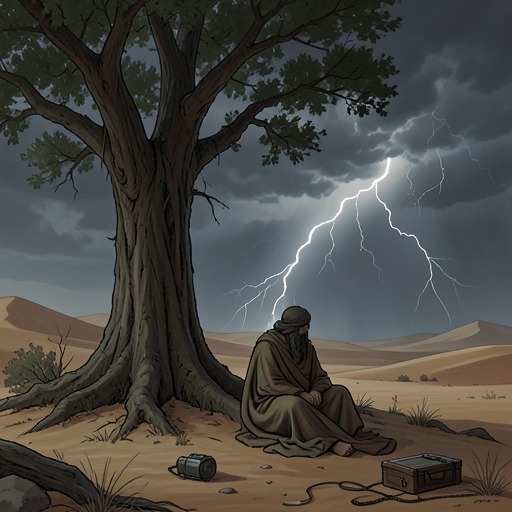
water-filled gourd
The Glass Bead GameThe water-filled gourd is the yogi’s plain, practical vessel, but in Dasa’s story it becomes the hinge between an ordinary errand and a life-changing lesson in Maya. Sent to fetch water after asking the yogi to explain the word, Dasa leaves the gourd by the spring when Pravati appears; later he finds himself there again, holding the filled vessel, as the vast apparent history of his life collapses into a brief experience. He first empties and throws it aside, then picks it up again and carries out the task. When he returns, the yogi receives him as a disciple. The vessel makes the difference between insight as an idea and service as an action.
The Vessel and the Request
The gourd enters this episode as part of a simple exchange. Dasa has asked the yogi to teach him about Maya, recalling the old man’s laughter and his exclamation when Dasa had recounted his life. Instead of explaining the idea in words, the yogi turns toward his hut, gives Dasa the emptied water-filled gourd, and gestures for him to wash his hands. He pours out what remains into the ferns and sends Dasa to fetch fresh water. The lesson begins as an assignment, not a discourse: Dasa is to fill the vessel and bring it back.
At the spring, the familiar errand becomes emotionally unsettled. Dasa drinks, rises carefully with the full gourd, and hears Pravati calling. When she appears, he drops the vessel and runs to her. His attention returns at once to the love and life he believes he has regained; he forgets the yogi, the hermitage, and the water left behind. In the scene’s immediate terms, the gourd is simply abandoned. In the episode’s structure, however, that interruption separates the assigned task from the apparent world that sweeps Dasa away.
The Gourd at the Return
After the apparent life of princely rule, family, conflict, and loss, Dasa comes back to awareness in a forest. The change is marked by the objects and surroundings he recognizes: he is holding the water-filled gourd, standing beside the spring, with the yogi’s hut beyond the ferns. The vessel establishes continuity across the break. Dasa has not returned from the apparent events with a new possession or a different task; he is still carrying out the same errand that began when he asked to learn about Maya.
The gourd also gives the recognition a material consequence. Dasa understands that the life he experienced was not simply nothing: it was Maya, and its remembered images remain with him. He stands shaken and in tears, while the water spills over the rim and onto his feet. The vessel in his hands makes visible the mismatch between the immense emotional weight of the experience and the short interval of the errand. To the yogi, Dasa has been gone only about fifteen minutes; to Dasa, he has undergone what feels like a whole life, including attachments and losses that have now been overturned.
Refusal, Service, and Acceptance
Dasa does not immediately treat the gourd as a reassuring sign or resume the task without resistance. After reflecting on the experience, he lets the water spill, empties the vessel, and throws it into the moss. He no longer wants wife or child, throne or victory, revenge, happiness, power, or virtue; he wants only an end to the turmoil. The act of discarding the gourd belongs to this rejection of the cycle of experience. Yet the revelation has not made the task meaningless. Dasa reasons that if there is no final escape from life’s movement, he may as well return to the service that was asked of him rather than continue contemplating self-destruction.
He takes the gourd again, fills it carefully, and carries it back to the yogi. This choice redirects Dasa from the desire to extinguish himself toward obedience and service: carrying water is an assignment he can complete, while the yogi has no need to command him by force. When Dasa arrives, the master’s questioning, compassionate, and amused look recognizes the spiritual ordeal behind what is, on the surface, a short trip to the spring. The yogi accepts Dasa as a disciple through that look. The gourd’s return therefore completes the lesson’s practical arc: Dasa does not master Maya by explaining it, but responds to his recognition by resuming the humble task.
Narrative and Symbolic Role
The water-filled gourd is not presented as magical in itself. Its importance comes from the sequence of ordinary actions attached to it: the yogi empties it, Dasa carries it to the spring, drops it when Pravati appears, finds it again upon awakening, empties it in despair, and finally refills it and returns. Each change in Dasa’s relation to the vessel tracks a change in his orientation—from a requested lesson, through absorption in apparent life and rejection of the task, to a renewed willingness to serve.
Its central role is to anchor an experience that threatens to dissolve every distinction between reality and dream. Dasa’s apparent life feels crowded with years, desires, grief, and consequences; the gourd remains part of the small present-tense errand that encloses it. The water spilling from the vessel is not a solution to the question of Maya, but a concrete sign of Dasa’s disorientation and of his need to decide what to do next. When he finally carries the refilled gourd to the yogi, the vessel connects awakening to discipline and begins their master-disciple relationship.